
Into the Fog: A Morning with Adirondack Loons
Updated: Aug 31
On August 15, I led a loon photography workshop in partnership with the Adirondack Center for Loon Conservation (ACLC). These special paddles combine wildlife photography with loon education, giving participants the opportunity to photograph Adirondack loons while learning more about their behavior, natural history, and the work being done to protect them. A portion of the proceeds from each paddle is donated to ACLC to support their ongoing loon research and conservation efforts!
We met at 6:30 a.m., and the morning immediately presented us with a challenge: fog. Lots of it. Visibility was extremely limited, making it difficult to spot birds across the lake.

Before launching, I shared a few photography techniques for working through fog, including adjusting camera settings and using the limited visibility to our advantage. Despite not being able to see far, we certainly knew we weren't alone. Loons were constantly flying overhead, giving their distinctive flight call - a rapid, high-pitched tremolo often used while traveling between lakes and territories.
After some brief introductions, we launched our kayaks and paddled into the fog. Slowly, loons began to appear: first two, then five, and eventually around eight birds scattered across the lake. By about 7:00 a.m., the fog began to lift, making both spotting and photographing the birds much easier. We watched groups of loons socializing, something we commonly see this time of year as the breeding season winds down and birds begin spending more time interacting outside of their individual territories. Since the loons seemed completely uninterested in us, we continued toward a territory where two chicks had been spotted.

Along the way, a juvenile Bald Eagle flew from a tree along the shoreline. Eagles are natural predators of loon chicks, so we hoped it wouldn't discover the family we were heading toward. Heres a photo by paddle attendee Destin Danser!

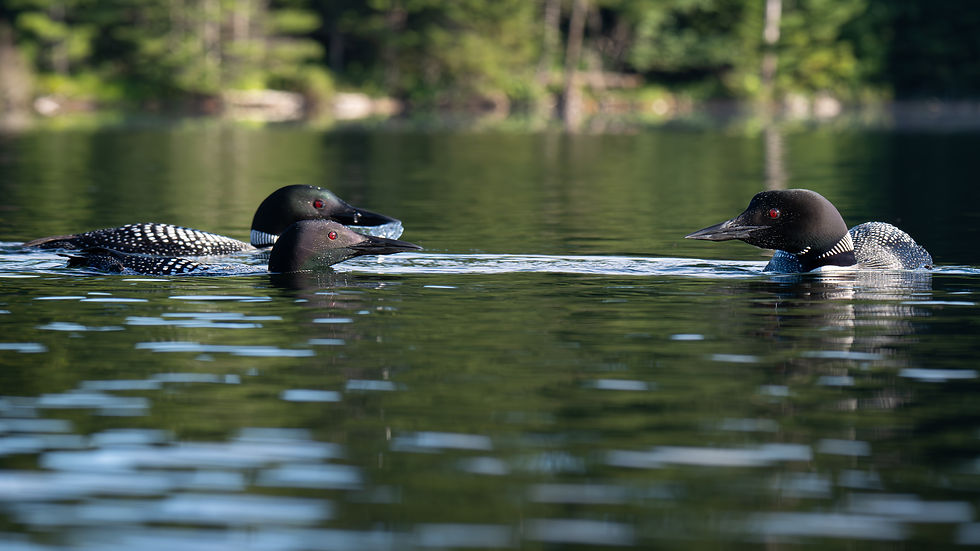
As we continued paddling, loons kept flying overhead. Between the birds we saw and heard, I'd estimate we encountered probably close to 20 loons throughout the duration of the paddle! We also witnessed a brief territorial dispute. Loon conflicts can involve chasing, diving, splashing, and dramatic wing rowing, where a loon races across the surface while beating its wings and using its feet to propel itself forward. This dispute was not quite that dramatic - the birds were fighting underwater for most of the time. On the left, there is a presumably mating pair (perhaps the pair with chicks on the lake) going against a lone bird on the right.
Eventually, we reached the territory with the two chicks. At first, we couldn't find them. Then two adults entered the area, one flying in, and we noticed two tiny shapes tucked against the shoreline. The chicks were so well camouflaged they looked like little floating logs. Their parents soon began feeding them, and for whatever reason, crayfish were clearly the meal of choice that morning. We watched the adults repeatedly dive and return with food for their chicks.
Even as they fed, the adults remained alert. An intruding loon entered the territory, and both adults left the chicks to confront it. The dispute was short-lived, and the parents quickly returned to feeding. Whenever another loon flew overhead, they would pause and look up, seemingly checking to make sure the passing bird wasn't coming in to land.

After watching the family for a while longer, we paddled back to shore and called it a morning after a brief encounter with a loon hunting about 20' from shore. It was an incredible morning on the water - fog, flyovers, territorial disputes, and some wonderful parent-chick interactions. More than anything, it was a great reminder that the best wildlife photography often comes from simply slowing down, staying observant, and letting the animals tell the story.
Interested in joining a guided wildlife or loon photography paddle?
I offer private and small-group trips focused on photographing wildlife in their natural habitat, with tips and techniques for capturing the perfect shot from the water. Email me at andrewhudnut247@gmail.com for upcoming dates and details, or visit my Workshops page to see what we have planned next!


Comments